 chainscore.net
Tokenisation
How real estate tokenization works
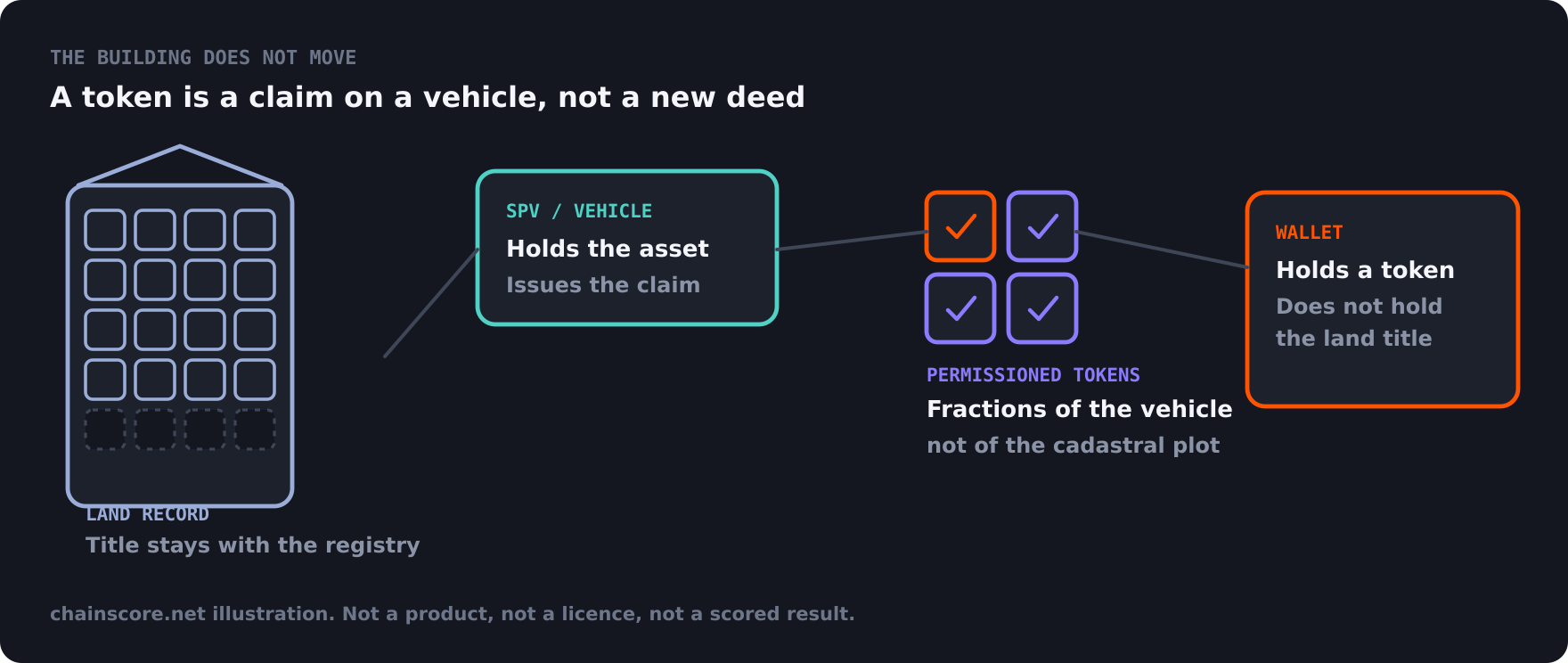
Tokenizing a building does not move the building, and it does not rewrite the land register. It usually means a named vehicle holds the asset in law, and a permissioned token represents a unit of that vehicle. chainscore.net screens wallet history. It does not issue the token, underwrite the credit, or act as the land registry.
What “tokenizing a building” actually means
A land register records who holds title to a plot. A permissioned token records who may hold a unit of a vehicle that, in turn, holds that plot. Those are different books. Marketing copy that says “the building is now on-chain” is collapsing them.
In the usual construction the asset stays where the law already put it. A company, fund or similar vehicle owns the property. The token represents a share, a note, or another claim on that vehicle. Transfer of the token is meant to transfer the claim, not to walk into the cadastre and overwrite the deed.
That is why a wallet that holds the token is not, by itself, the landlord. It is an address that the issuer has allowed to hold a unit. Whether that unit is a security, a utility, or something the local statute has not named yet is the issuer’s filing, not a field chainscore.net invents.
Four planes that must stay apart
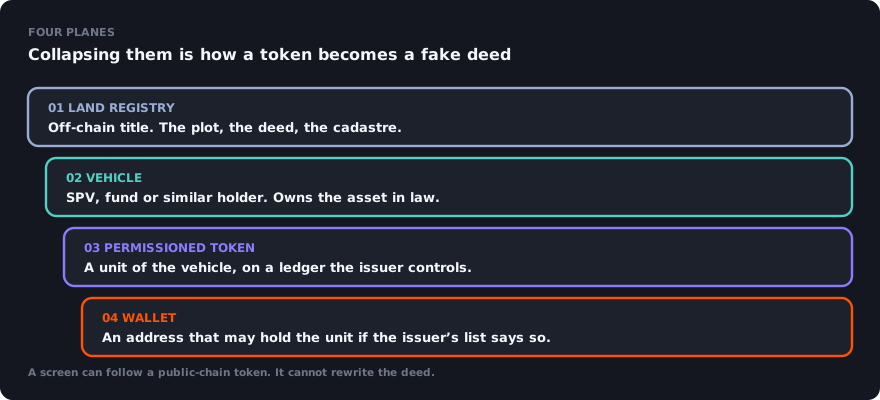
Keep four altitudes in view and most of the confusion falls away. The land registry is off-chain. The vehicle is a legal person. The token is a unit on a ledger the issuer controls. The wallet is an address that may hold that unit if the issuer’s list says so.
A useful picture is a building, a company that owns it, a share certificate, and a brokerage account. Nobody confuses the certificate with the bricks. Tokenization is the same stack with a programmable certificate. The programmability is the point: the token can refuse a transfer the share register would have to chase after the fact.
What the token cannot do is replace the deed. If the vehicle is badly formed, or the title is encumbered, or the offering never closed, the ledger will still show units. A screen of those units will not repair the title.
How the token is prepared
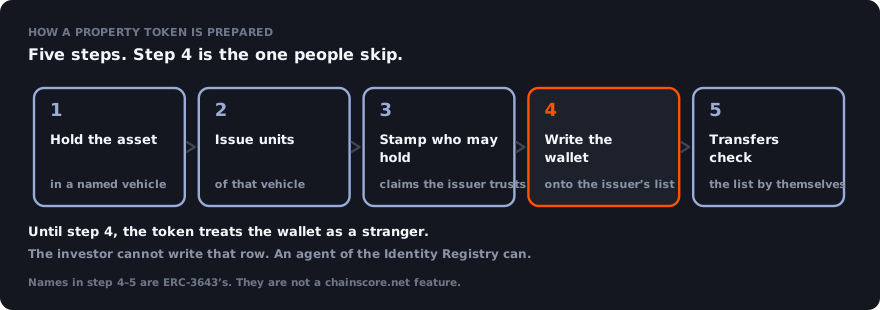
The walk is the same shape as any permissioned security token. First the asset is held in a named vehicle. Second the vehicle issues units — often an ERC-3643 token, sometimes another permissioned standard, sometimes a private book with no public contract at all. Third the issuer names who may stamp an identity, and those stamps are added. Fourth a wallet is written onto the issuer’s list. Fifth transfers check that list by themselves.
Step 4 is the one people skip in their heads. An investor can hold a valid identity with valid stamps and still not be on tonight’s list. The ERC-3643 name for that list is the Identity Registry. The function that writes the row is registerIdentity. Only an agent of the registry may call it. The investor cannot add themselves. The follow-up note on how a permissioned token checks an identity walks that row in full.
Not every property token uses ERC-3643. Some live entirely on a bank’s permissioned ledger. The legal shape is still the four planes. The difference a screen cares about is whether any public-chain hop exists at all.
Two doors on a transfer
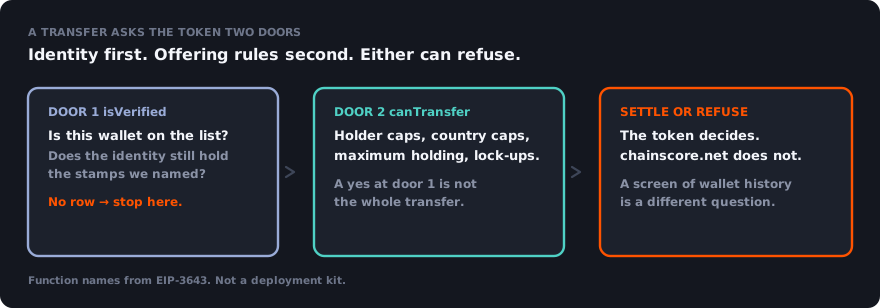
When a transfer starts, a T-REX token does not ask a person to re-read the file. It calls isVerified on the Identity Registry and passes the wallet — usually the receiver. No row, and the walk stops. A row is not yet a yes: the identity still has to hold the stamps the issuer named, signed by a trusted claim issuer, and not expired.
A yes at that door is still not the whole transfer. canTransfer asks the offering’s own rules: a cap on holders, a cap per country, a maximum holding, a lock-up. Identity gets you into the building. The second door is the floor you are allowed on.
chainscore.net does not implement either door. A wallet screen is a third question — where the funds in a public address came from, which hops they took, whether a public indexer can see the book. Mixing that answer with isVerified is how “Verified by chainscore.net” gets misread as KYC. It is not KYC. It means a label is documented in the label book.
Rent, servicing, and what stays off the chain
Income does not appear because a token exists. Rent is collected by a manager, a servicer, or the vehicle itself. Distributions, NAV, repairs, insurance and tax are off-chain events. Some programmes reflect them as token actions; many do not. The ledger is not the property accounts.
Exit is the same. Selling a unit on a permissioned secondary still has to pass the two doors. Redeeming into the vehicle, or the vehicle selling the building, is a corporate action. None of that is a chainscore.net module, and none of it is inferred from a directory row.
Three lists that are not the same list
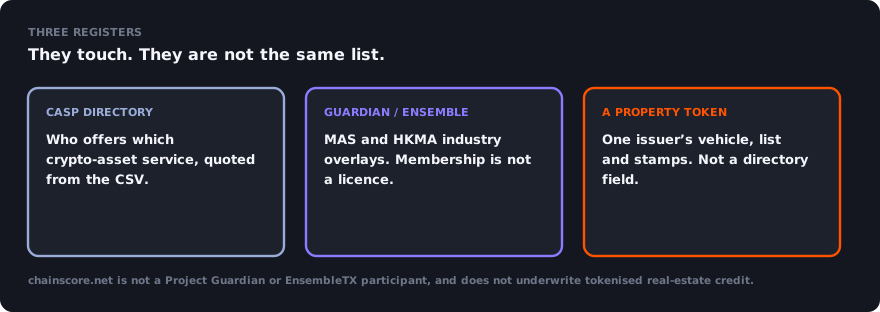
The chainscore.net directory holds 28 entities across 51 service rows. The Tokenization & DLT bucket inside it is 11 houses and 11 service rows — quoted from the CSV, not scored. Those rows name origination and servicing books: Sygnum’s Tokenization Engine under Swiss DLT law, BNY’s Tokenization Infrastructure, Goldman Sachs DAP, J.P. Morgan Tokenized Capital, Citi Token Services. They do not map a wallet to a flat.
Project Guardian (MAS) and Project Ensemble / EnsembleTX (HKMA) sit beside that directory as a sourced overlay. They are industry groups and a tokenised-deposit pilot. Membership is not a licence, and chainscore.net is not a participant in either network. The overlay does not underwrite tokenised real-estate credit and does not state onboarding criteria for either sandbox.
A property token’s Identity Registry is a third list: one issuer, one vehicle, one guest list. It is not a directory field. It is not a Guardian workstream. registerIdentity is not inferred from a tokenization row. An unlabelled house stays unknown.
What a screen can and cannot see
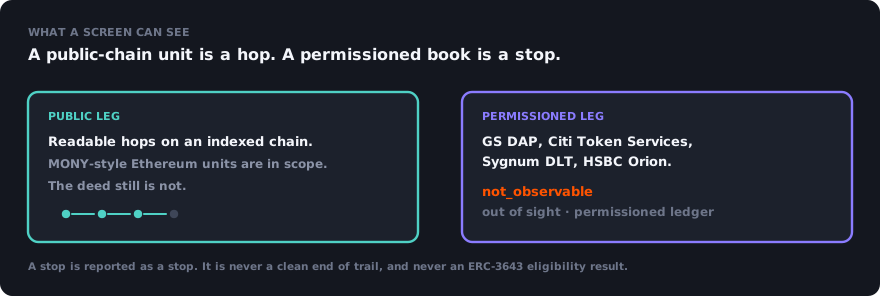
Where a unit lives on a public, indexed chain, ChainTrace can follow the hops. J.P. Morgan’s MONY tokens on Ethereum are the example already used on the ONCHAINID note: in indexer scope. The deed still is not.
Where the book is permissioned, the finding is not_observable — out of sight, permissioned ledger. GS DAP, Citi Token Services, Sygnum DLT and HSBC Orion are named on every report as unindexed ledgers. A stop is reported as a stop. It is not a clean end of trail, and it is not a claim that the investor was, or was not, on the issuer’s list.
PAWS Liquid LLC is the listed reviewer for real-estate and tokenisation support on the Position rail. It does not run a bank and does not issue the token. chainscore.net introduces a house that publishes a tokenisation or lending row; it does not underwrite, does not certify those firms, and does not process eligibility. The facilitator still verifies the documents.