 chainscore.net
Regulation
USDC as the cash leg in SEC-related trading
USDC is the cash token in a growing set of SEC-related trades. It is not the security. The Division of Corporation Finance’s April 2025 staff statement describes when a USD stablecoin’s mint and redeem is not an offer of securities. The GENIUS Act will, when it times in, take payment stablecoins issued by a permitted issuer out of the statutory definition of “security”. chainscore.net screens wallet history. It does not mint USDC, operate an ATS, or decide either of those questions.
What “supported in SEC-related trading” actually means
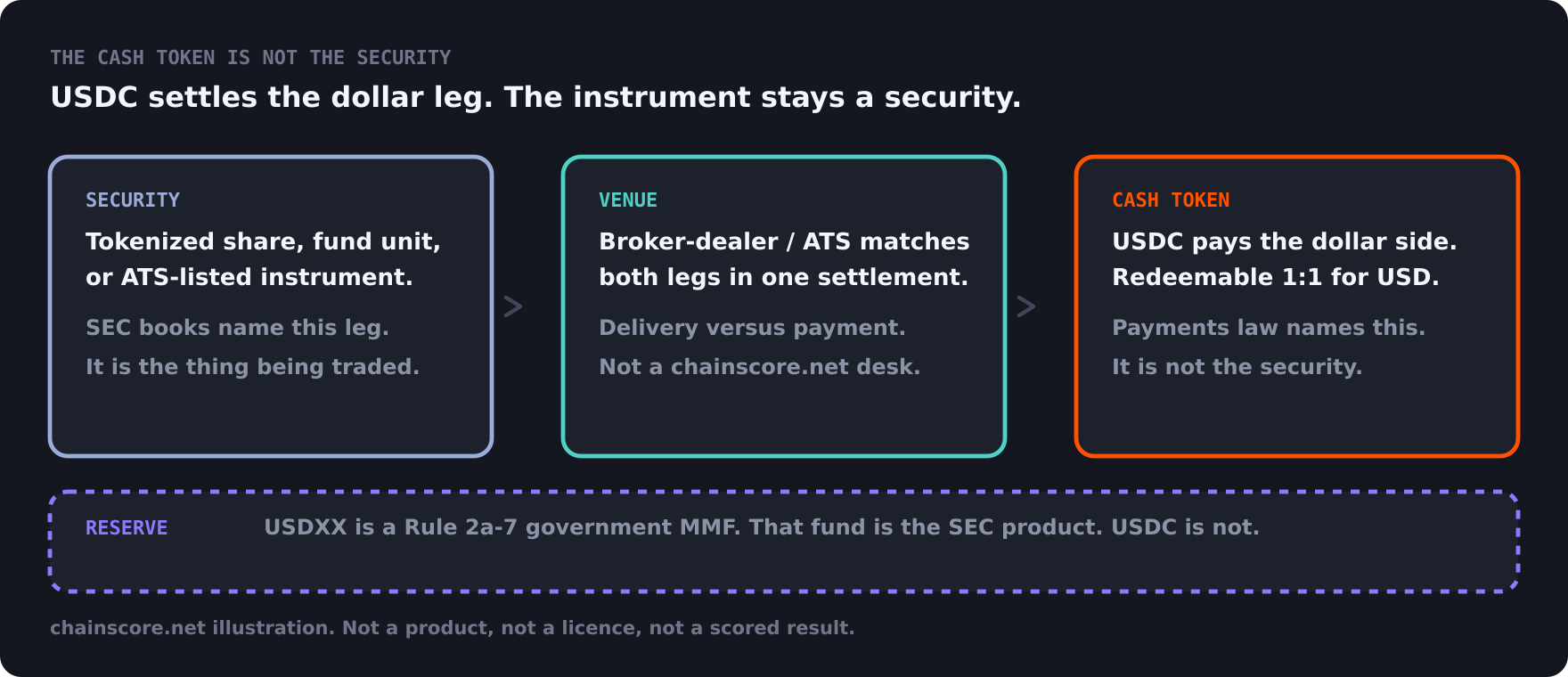
USDC is a digital dollar issued by Circle affiliates. Circle’s own page says it is redeemable 1:1 for US dollars and 100% backed by cash and cash-equivalent assets. The majority of that reserve sits in the Circle Reserve Fund (USDXX), which BlackRock’s prospectus describes as a government money market fund under Rule 2a-7 of the Investment Company Act of 1940. Custodian: The Bank of New York Mellon. Manager: BlackRock. That fund is an SEC product. USDC is not.
Circle Mint is the institutional window that mints USDC against a USD deposit and burns USDC against a USD payout. Circle says Mint is not available to individuals or small businesses. Secondary-market holders buy and sell USDC through intermediaries. Collapsing those two windows is how “anyone can redeem at the issuer” gets misread as a retail right.
“Supported in SEC-related trading” does not mean the Commission registered USDC as a security, and it does not mean chainscore.net clears a USDC-versus-share trade. It means three sourced facts sit next to each other: a cash token used as payment or settlement, an instrument that is a security, and a venue that is allowed to match them. Keep those three apart and the rest of the note is a walk, not a slogan.
Four planes that must stay apart
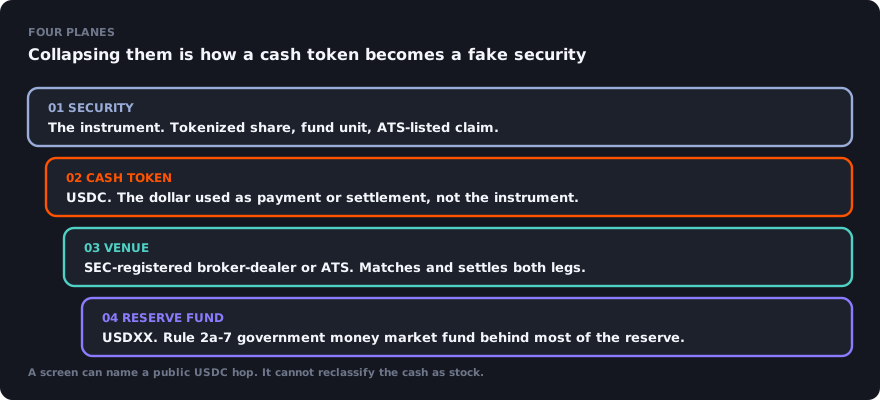
Keep four altitudes in view. The security is the instrument: a tokenized share, a fund unit, an ATS-listed claim. The cash token is USDC, used as payment or settlement. The venue is the SEC-registered broker-dealer or alternative trading system that matches both legs. The reserve fund is USDXX, sitting behind most of the dollars that back the cash token.
A useful picture is a share certificate, a dollar bill, a brokerage, and a money-market fund that holds the issuer’s cash. Nobody confuses the bill with the certificate. USDC in an SEC-related trade is the same stack with a programmable bill. The programmability is the point: the cash leg can move on the same ledger as the security. The bill does not become stock.
What the cash token cannot do is absorb the securities analysis. If the instrument is unregistered, or the venue is not allowed to match it, or the offering never closed, a labelled USDC hop will still show dollars moving. A screen of those dollars will not repair the filing.
How the cash leg is prepared
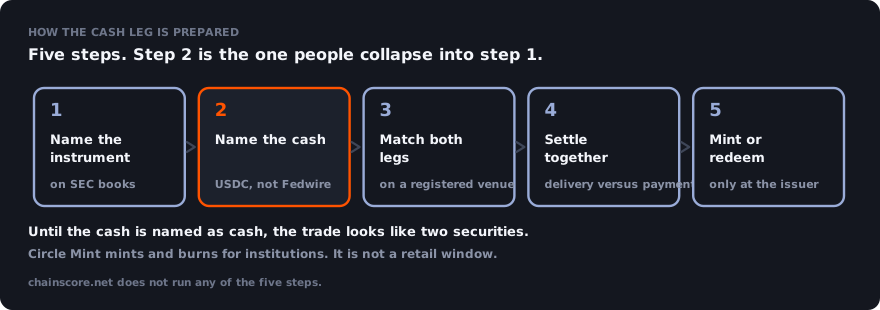
The walk is the same shape as any delivery-versus-payment trade, with the dollar replaced by a token. First the instrument exists on SEC books — a 1940 Act fund unit, a tokenized security at a transfer agent, an ATS-listed claim. Second the cash is named as USDC, not Fedwire. Third a registered venue matches both legs. Fourth they settle together. Fifth institutions mint or redeem USDC at Circle; everyone else uses an intermediary.
Step 2 is the one people skip in their heads. A trade that pays in USDC is still a securities trade on the instrument side. Paying in a cash token does not take the instrument out of the Securities Act, and it does not put the cash token into it. Mixing those two sentences is how “USDC trading” gets misread as “USDC is the security.”
Circle’s 11 April 2024 notice is the plain example of step 4 on a named fund. Holders of the BlackRock USD Institutional Digital Liquidity Fund (BUIDL) can transfer shares to Circle on the secondary market and receive USDC. That is an off-ramp from a tokenized fund unit into the cash token. It is not a finding that BUIDL is USDC, and it is not a chainscore.net module.
Two doors on a trade
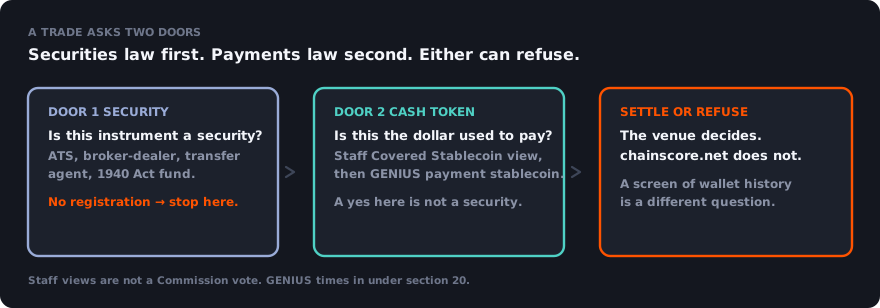
On 4 April 2025 the SEC’s Division of Corporation Finance published a Statement on Stablecoins. It is staff’s view, not a vote of the Commission. For “Covered Stablecoins” — USD 1:1, redeemable 1:1, backed by low-risk liquid reserves at or above the redemption value — the Division’s view is that the offer and sale in the manner described do not involve the offer and sale of securities under section 2(a)(1) of the Securities Act or section 3(a)(10) of the Exchange Act. Persons minting and redeeming those Covered Stablecoins need not register those transactions under the Securities Act.
The staff did not name USDC. Circle’s view, on its USDC page, is that USDC is a Covered Stablecoin as the statement defines it. A Commissioner published a dissent the same day. This note quotes both and does not pick a winner. Staff views are not a Commission rule, and chainscore.net does not decide Covered Stablecoin status.
The GENIUS Act (Public Law 119-27, 18 July 2025) is the second door, still timing in. Section 17 amends the Securities Act, the Exchange Act, the Investment Company Act, the Advisers Act and SIPA so that “security” does not include a payment stablecoin issued by a permitted payment stablecoin issuer. Section 4 forbids that issuer from paying the holder any form of interest or yield solely for holding, using or retaining the token. Section 20 times the Act to the earlier of 18 months after enactment — 18 January 2027 — or 120 days after final implementing regulations. Until that clock runs, the staff statement is the live federal-securities view this note can cite. Circle describes a federal trust-charter path. This note does not treat Circle as already a permitted payment stablecoin issuer.
Where USDC actually shows up beside a security
The reserve is the quietest SEC product in the stack. USDXX is a Rule 2a-7 government money market fund. USDC holders do not hold USDXX. The fund holds Treasuries, cash and overnight Treasury-secured repurchase agreements for the reserve. Earnings on that reserve stay with the issuer’s structure; they are not a yield on USDC. Calling the cash token a money-market fund is the same collapse as calling it a security.
On 4 May 2026 Securitize announced a FINRA Continuing Membership Application for Securitize Markets, LLC, an SEC-registered broker-dealer that operates an SEC-regulated ATS. The announcement says the CMA lets that broker-dealer custody tokenized securities and facilitate atomic swaps that clear and settle between tokenized securities and stablecoins on-chain. The release says “stablecoins.” It does not name USDC. This note does not read the CMA as a USDC listing.
Staff Accounting Bulletin No. 122, effective 30 January 2025, rescinded SAB 121’s presentation of crypto-asset safeguarding as a balance-sheet liability and matching asset. Custodians now assess a loss contingency under ASC 450-20 or IAS 37. That is accounting staff guidance for firms that file with the Commission. It is not a trading licence, and it is not a finding that USDC is or is not a security.
Three lists that are not the same list
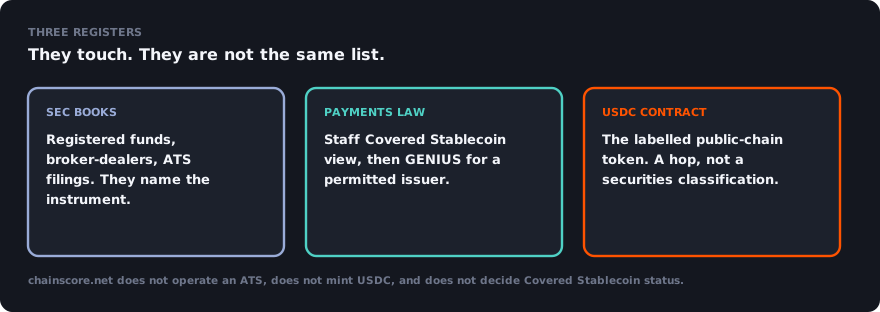
SEC books name the instrument and the venue: 1940 Act funds, broker-dealer registrations, ATS filings, transfer-agent registrations. USDXX lives on that list. Securitize Markets lives on that list. USDC does not.
Payments law names the cash token. Today that is the Division’s Covered Stablecoin statement, plus Circle’s own view that USDC fits it. When GENIUS times in, a payment stablecoin issued by a permitted issuer is carved out of “security” by statute. Membership of that category is an issuer fact, not a directory field chainscore.net invents.
The public USDC contract is a third list: the labelled token on indexed chains. Bridged deployments cluster as the same asset in the label book. That cluster is how a report avoids listing six unrelated counterparties for one cash token. It is not an ATS filing, and it is not Covered Stablecoin status.
What a screen can and cannot see
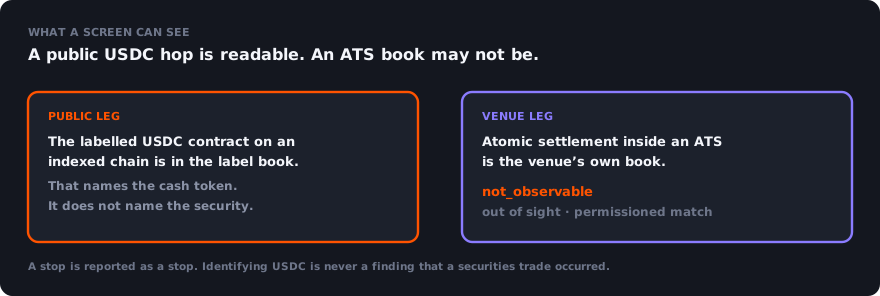
Where USDC lives on a public, indexed chain, ChainTrace can follow the hops. The Ethereum contract 0xa0b86991c6218b36c1d19d4a2e9eb0ce3606eb48 is in the label book as USDC. Naming that contract names the cash token. It does not name the security that was, or was not, on the other leg.
Where the match sits inside a broker-dealer or ATS book, the finding is not_observable — out of sight, permissioned match. Atomic settlement the venue describes as on-chain may still be a book a public indexer cannot enter. A stop is reported as a stop. It is not a clean end of trail, and it is not a claim that a securities trade occurred, or did not.
PAWS Liquid LLC is the listed reviewer for real-estate and tokenisation support on the Position rail. It does not run a bank, does not issue USDC, and does not operate an ATS. chainscore.net does not mint, does not clear, and does not decide Covered Stablecoin status. Identifying USDC is never a finding that a securities trade occurred.